
Billet-Rail Oil Pans, Accessories & Options
|
Our exclusive two-piece oil pans and Baffle Balls are examples of the leading-edge technology that all types of racers have come to expect from Jeff Johnston's Billet Fabrication. Every aluminum oil pan features 3/8-inch-thick rails and end seals milled from 6061 billet, then heliarc-welded to .090-inch, 3003-alloy walls (except for marine pans, whose walls are fully-.125-inch thick). Billet rails prevent warping and leaking after repeated on/off cycles, keeping the gaskets (and oil) in place after years of use.
Billet Fabrication pans offer several standard features that we feel are essential for serious racers. Whether for drag-racing, oval-track, road-racing or marine applications, every pan provides a full "power kickout" that helps keep oil away from the crankshaft, reducing the power-loss potential. We strive to provide the biggest kickout possible (up to four inches) that still allows the pan to fit your vehicle, without modifications to either the pan or chassis components. We specialize in engineering high-capacity aluminum pans that clear stock frames (e.g., Fox Mustangs and popular GM bodies of the 1950s, 1960s and 1970s). We're often asked, "How much oil should I put in my pan?" To determine and verify the oil capacity of any pan, position the pan so that the rails are level. Fill the pan with water, in one-quart increments, until the fluid reaches the top of the baffle bulkheads. The amount of water required is the oil capacity of your pan. Oil capacity follows the size of the kickout, with the four-inch maximum allowing 11 quarts to reside in a wet-sump pan. For example, many drag racers with wet-sump oiling systems have detected an alarming drop in oil pressure after hitting the brakes following a run or a burnout. The needle of the pressure gauge will sometimes drop all the way to zero! For years, a common top-end solution called for killing the motor in the lights, prior to hitting the brakes or parachute. After burnouts, a gradual slowing of the vehicle has minimized pressure losses. However, these were both band-aid fixes, at best, to a continuing problem. Shop experimentation and extensive track testing (with cameras videotaping the oil-pressure gauge) revealed that common, trap-door baffles are doing a poor job of keeping oil in the sump under hard braking. While trap doors do slow down the movement of oil from the back of a pan to the front, a lot of oil still manages to get through the partially-open doors. After experimenting with various types of restrictors, our engineers developed the exclusive Baffle-Ball system.
A windage screen or tray is another standard feature of Billet Fabrication pans, though we have seen evidence that a kickout-style pan may do a more-effective job of keeping the oil off the crankshaft than a windage screen, or tray. One prominent engine builder and Billet Fabrication customer, Ken Duttweiler, believes that, in some applications, a screen can excessively inhibit oil flow back down to the sump — keeping more of it up near the crank than is desirable. Drag-racing-champion Bill Maropulos is another engine builder who has provided invaluable feedback since becoming one of our customers. Maropulos reveals that he has realized dyno-verified power gains after taking the screen out when using a high-kickout pan. He also tells us that, after starting out with eight to nine quarts of oil in a large pan, cutting back to six quarts resulted in more power on the dyno. Dropping to four quarts was even better: The difference was in the range of 25 to 30 horsepower! We emphasize that these experiments were conducted on a stationary dyno; not in a race car going down or around the track. However, there are two things that "make power in the pan," as it were: (1) keeping the oil as far from the crankshaft as possible; (2) providing a larger pan to increase the area for crankcase pressure to dissipate. Both of these conditions are enhanced by decreasing the volume of oil in the pan. No, we do not recommend draining half of your oil before going out on the track! If someone is inclined to experiment along these lines, we would hope that testing would be accomplished carefully and gradually, with an exceptionally close eye monitoring the oil-pressure gauge at all times — especially during braking — and a ready finger on the kill switch! Because our kickout typically extends beyond the block's pan rails, we provide two methods of attaching the pan to the block. We generally build our pans with "pass-through" tubes, through which long mounting bolts secure the pan to the block. However, in a stroker motor, the tubes may interfere with the crankshaft. In this case (or as per a customer's preference), we eliminate the tubes and provide threaded bosses and plugs in the bottom of the pan. These provide access for a long-handled hex wrench to reach the standard-length mounting bolts. (There is no extra charge for either of these options.)
All oil pans are individually checked on our in-house engine blocks to verify the fit before they are shipped. However, due to the variations found in production blocks and both stock and aftermarket front covers and main caps, our standard pans may not precisely fit every application. Therefore, to minimize the problems that can result, we suggest that a thin piece of cardboard be used to trace and cut out the contours of your front cover and rear main cap, then sent to us for exact measurement. At Jeff Johnston's Billet Fabrication, the difference begins with the billet rails and extends to the continual refinement and innovation of our products — as evidenced by our ever-expanding line of two-piece oil pans; by the innovative three-step configuration; and by the exclusive Baffle-Ball system. We take great pride in building what we feel are the finest oil pans available, and in giving our customers the advantages of performance, fit and durability. |
 In our popular two-piece pans — offered for both wet-sump and dry-sump applications — all three rails are CNC-machined from billet aluminum. (Beware of competitive models using sheet-metal rails to attach the upper section to the engine block.) Our upper section always remains mounted to the block; the easily-detached lower portion features captive-O-ring sealing that eliminates the need to deal with gaskets and/or silicone after every bottom-end inspection. Two-piece pans are fast becoming essential for anyone utilizing a power adder and, consequently, concerned with main-bearing life. Engine builders and dyno operators who regularly check the condition of the bearings and crankshaft appreciate the time savings and convenience of this design. Two-piece pans are now available for all popular small-block and big-block V8s.
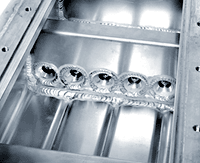 When using pans with this much fluid capacity, the internal baffles play a major role in keeping sufficient oil in the sump to prevent loss of oil pressure under hard braking. Excellent trap-door baffles are standard in all Billet Fabrication pans. Now, drag racers concerned with sealing off the sump area during hard braking can also choose from three optional, affordable innovations: a three-step pan design; new "anticlimb" baffles; or our exclusive, internal Baffle Balls (which replace trap doors in any pan).
 Speaking of stroker cranks: For stroker applications, Billet Fabrication pans are manufactured with built-in stroker notches, designed to allow clearance for the maximum stroke possible with the particular engine block. Therefore, if a racer ever wants to step up his/her combination in this way, a new pan will not be needed. (As much as we like building and selling pans, we see no reason to require a customer to replace one just because he or she wants the crank and rods to take up a bit more room in the bottom end than originally planned.)